Lutheran Leaders Visit Pope Francis.
It is remarkable that we have come so far in just the last fifty years. There was a time here in the U.S. when Lutherans and Catholics wouldn’t even acknowledge one another’s presence. I, a Catholic, was taught Lutherans were heretics and Martin Luther, a renegade monk.
A Lutheran minister told me long ago that that his mother taught him to never trust a Catholic. These days, it looks like the pope and the Lutherans are trying to trust one another.
We’ve come far by dialoging. Lutheran leaders who have been in the forefront of ecumenical discussion think it’s O.K., even good, to walk into the Vatican and meet the Roman Pope on his own turf. They hear him say that Lutherans and Catholics do not need to contend any more. That time is over. It is a time of healing now.
In his opening words, Pope Francis greeted his Lutheran guests as brothers and sisters in the Lord.
He encouraged both Lutheran and Catholic leaders to work on practical ways of achieving the unity that Christ, Our Lord, prayed for in John 17; 20-21.
I have been blessed to be friends with three wonderful Lutheran ministers in my life. Forty years ago, one of them gave me a print of the Last Supper (by P. C. Hodgell).
He wrote on the back of the print the following prayer: “…toward the time when we will be able to take communion together.”
Pope Francis thinks we are getting closer to that time.
Some Summer Birds Stay Behind in Winter.
We had a strong frost this am but a few mallards float defiantly in the bright sunlight on the ponds that I frequent .Canada geese waddle around on land, determined to pass the winter with us, too. There is not an abundance of food but somehow these winter residents eake out a living.
Yes, the crows are crowing and the Blue Jays seem always to be scolding. The chickadees flutter around close to me and hang on the bark on the sides of trees.
The snow birds (Juncos) haven’t arrived yet but soon flocks of them will liven up the scrub bushes and barren paths.
Summer is dying and the bushes are losing more leaves with every breeze. But, the birds are still here. And, so I will get up in the morning and see what they are up to.
Original Sin: It’s more than a Forbidden Bite.
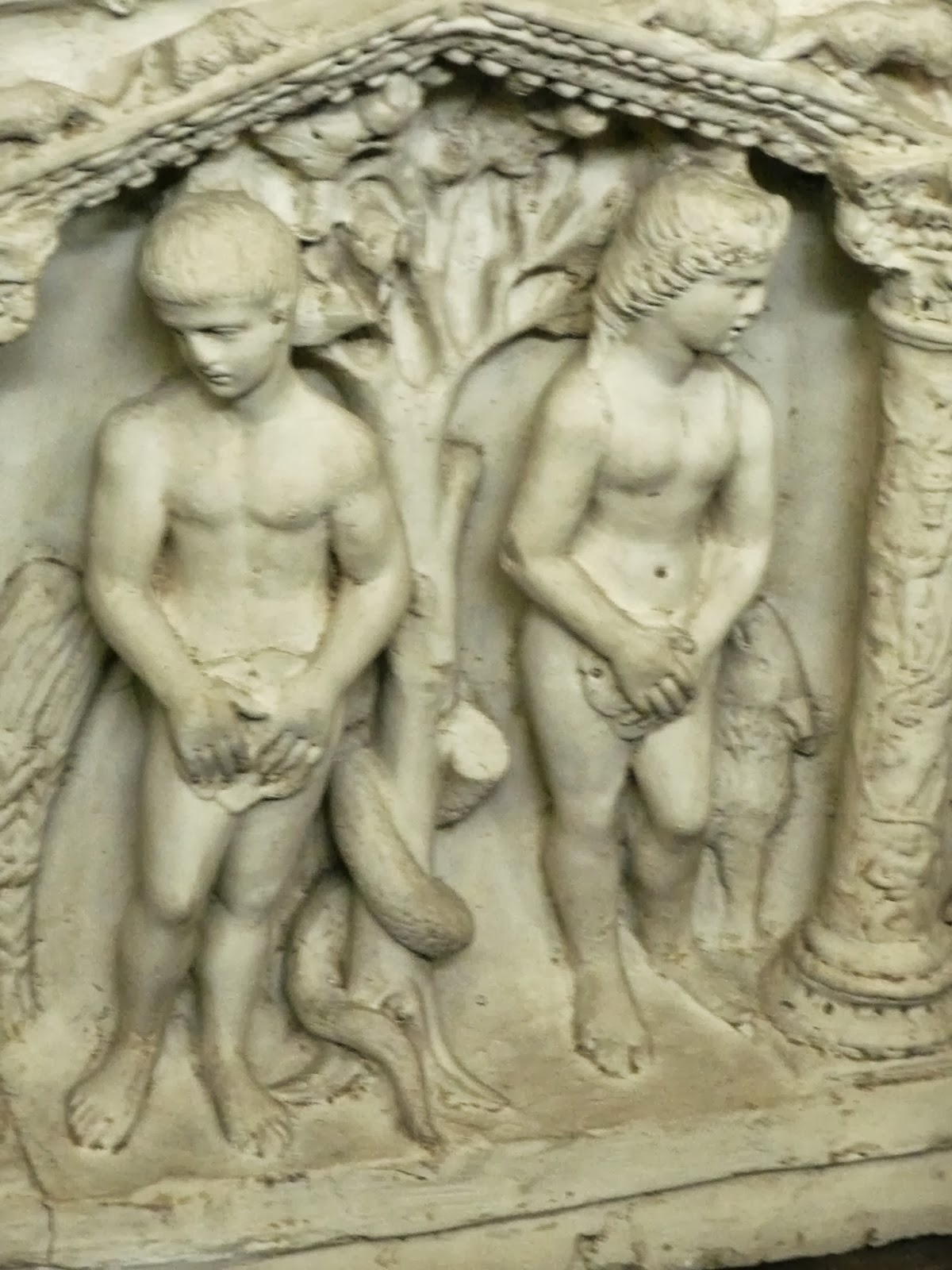
| Adam and Eve, detail of tomb (Gerald Watt) |
Read the “Confessions of St. Augustine” and you will begin to understand why we have to suffer simply because two young people picked and shared forbidden fruit. Why are we “attracted to evil” as one of the founders of my Congregation put the problem? Who would want to do bad? Who would choose to be evil?
Gentrification of the White-Tailed deer.
Four yearling deer stood still not ten feet from me in the first light of an October morning. With their light grey, furry, pointed ears, huge dark eyes and black noses, they appeared out of a cool mist and startled me. I had turned a corner on the rustic path that I walk most days — and there they were.
The deer were browsing some of the last green leaves of Summer and were mildly interested in me standing there so close by. They made no attempt to move away: they just stood there munching, looking at me. So, I excused myself…I really did –out loud! I felt like I had interrupted their breakfast.
I continued down the path thinking about the abundance of deer so present these days even in our cities and suburbs. These deer are gentrified, completely at peace with the walkers and talkers who move through their environment. They are not domesticated, just habituated to the humans who must seem so curious to them.
There are far more deer in America than when the pilgrims arrived. As the forests of the East and Midwest were leveled and agriculture took over as much of the land as was possible, more brush and what environmentalists call “edge” appeared. One example of edge is the strip of vegetation that farmers leave along creeks and rivers that pass through their land. That’s where many species of birds find food and cover. It’s where deer live, too. They don’t live in the forest.
Years ago, the world’s expert on moose, deer and elk was Margaret Altmann, a researcher whose home bordered the Bridger Wilderness Reserve near Yellowstone. I went with her once on horseback through forests and brush while she observed white-tailed deer through a monocular. Her riding horses were unshod and stealthily made their way without disturbing the natural behavior of wildlife.
I wonder what she would say about our citified deer. I know one thing: She would be curious to know how civilized deer differ in behavior from wilderness deer. Margaret Altman has been gone for many years now but I think, were she alive, that she would be amazed how these deer accept us within their territories.
The Song Sparrow Observer.
![]() |
| Song Sparrow, Melospiza melodia. (Wicki photo,Ken) |
Here was a woman, trained as a scientist who produced a remarkable account of the life history of the Song Sparrow, Melospiza melodia, simply by making detailed notes on her observations of this common species which she studied in her backyard and surrounding neighborhood for many years. No lab needed or wanted.
When I was at St. Louis University in a research master’s program, our lab did extensive studies on the Song Sparrow. At that time, the National Science Foundation helped support research into the inheritance of species-specific song. So, we isolated birds in sound proof enclosures and recorded their vocalizations.
However, I was allowed to study Song Sparrows in their habitats, too. I trudged through meadows and savannahs in and around St. Louis, Missouri making notes on my observations of this species and tape recording their calls and songs. I got so that I could easily identify Song Sparrows by their calls alone as well as by their song. Later, I did some field work at the University of Wyoming Research Center in Grand Teton National Park where Song Sparrows share habitat with Lincoln’s Sparrows and Fox Sparrows.
By observation I learned that Lincoln’s Sparrow is smaller than the Song Sparrow and with no dark spot on the breast. The Fox Sparrow has a dark spot on its breast but is larger than the song sparrow and chunkier.
Lincoln’s Sparrow and the Fox Sparrow had their own species-specific flight patterns and, of course, the songs were different than the Song Sparrow.
I wish I could have had the opportunity to thank Ms. Nice for her wonderful book on Song Sparrows. If I had not read her book, I might never have learned how important detailed observations are to an animal behavior project.. I might have thought that not being able to control the environment would lead me to unscientific results.
My experience was just the opposite. I was able to observe Song Sparrows in natural situations. To see males hop higher and higher until they reach a perch from which they would sing is something I could have never seen in a lab. Bobbing movements as they flew from one tree to another; “sneaking behavior” as the female indirectly returned to a nest which was well-hidden in a bush; males singing against one another to establish territory, these are behaviors I would never would have seen in a controlled laboratory environment.
I made notes carefully in day journals which became the basis of a small scientific contribution to the study of this species. Thanks, Ms. Nice.
Sources: Nice, M. M.. “Studies on the Life History of the Song Sparrow,” Dover reprint, 1964. Out of print but available used from Amazon.com.
Cornell University’s website is very helpful in differentiating Fox, Lincoln’s and the Song Sparrow.http://www.birds.cornell.edu/brp
Pope Francis Gives a Surprising Interview.
Pope Francis gave this response in an interview in September, 2013. The interviewer was Antonio Spadaro, S.J. and Pope Francis remarks were published in “La Civitta Cattolica.”
OMG! What modern pope has ever defined himself as, first of all, a sinner? What happens to our conception of the pope as the pre-eminent, holy, follower of Christ? A pope in our day is considered an icon of holiness. All you have to do is think of John XXIII, Paul VI, John Paul II and Benedict XVI.
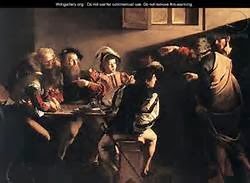
Pope Francis wants to shatter the image we might have of him as reigning above us all in holiness. Pope Francis calls to mind the painting by Caravaggio of the “The calling of Matthew.” The masterpiece hangs in the Church of St. Louis of France, in Rome. I saw it when I was in Rome two years ago.
In the painting, Matthew is in what appears to be a pub. Along with him are several of his henchmen and they are counting the days take.
One young man fingers the day’s haul and contemplates it. Jesus, barefoot, enters the pub with Peter. Jesus points to Matthew and says “Come follow me” as he points at him. Matthew points to himself as if to say, “Are you sure you want me?”
Matthew, a despised Jew who worked for Rome against his own people, is called by Jesus to fulfill a destiny which Matthew had as a member of the covenant people. Matthew was a ritually unclean Jew who gouged the poor and extorted from the rich. But, when called, he got up and followed Jesus as a member of the new covenant people.
Pope Francis feels he has been chosen through no merit of his own to be an apostle like Matthew.. Pope Francis does not set himself above us but situates himself with the rest of us sinners.
There is a quiet revolution going on in the Catholic Church. In this fiftieth anniversary year of the opening of the Second Vatican Council, Our Lord has given us as chief shepherd, a sinner in need of the healing call of God’s mercy, just like you and me.
Pope Francis is confident of that mercy and he knows that he is graced with the light of God. He wants us all to see the light.
John XXIII, the Saint Who Opened the Windows.
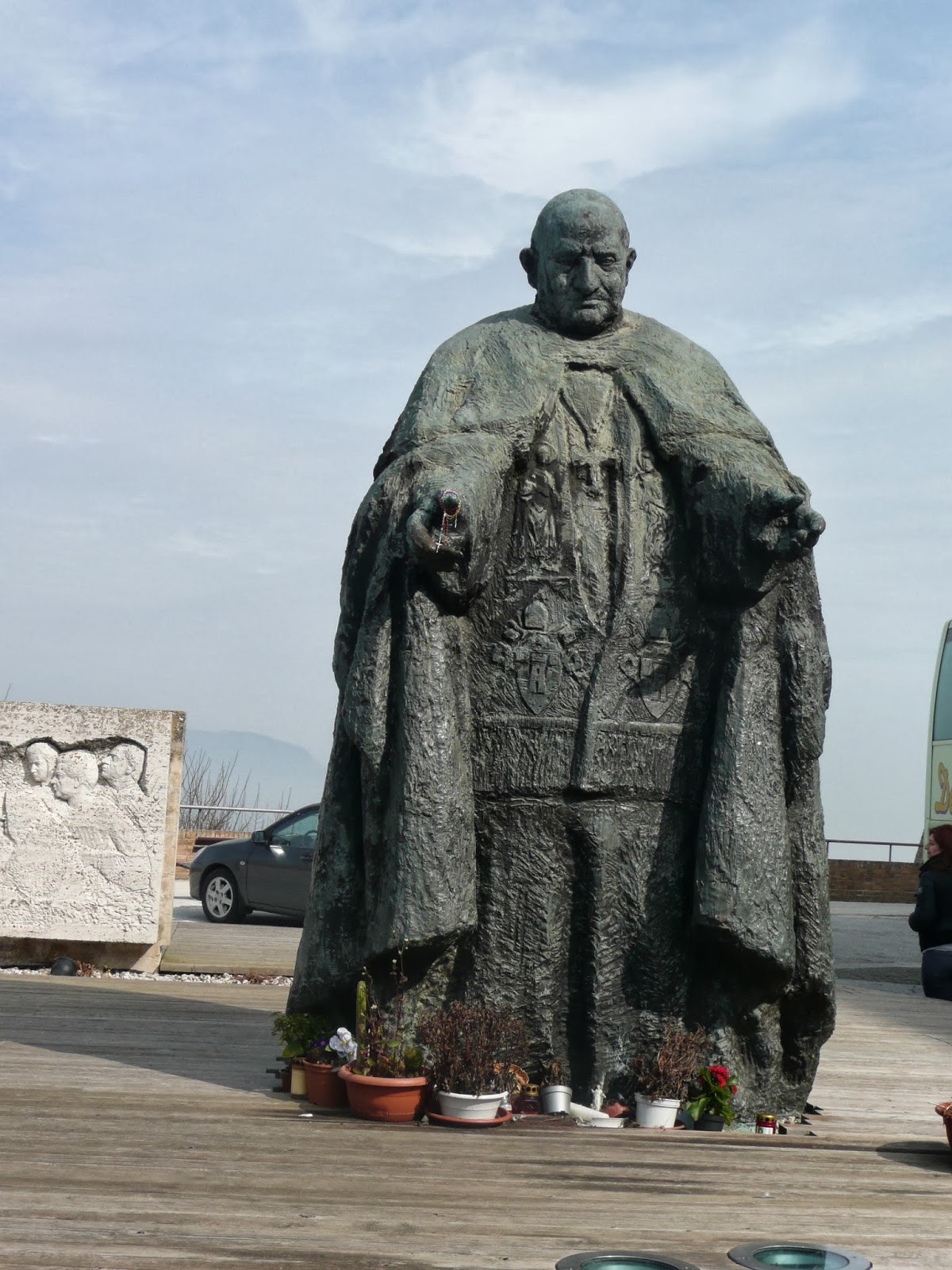
| Bronze statue of John XXIII, Italia (G,.Watt) |
I am old enough to remember when Pope Pius XII died and Angelo Roncalli was elected Pope. He took the name John XXIII. Someone remarked to me on seeing him for the first time: “He looks like a butcher!” Unlike the formal demeanor of Pius XII who seemed to have been carved out of a narrow block of granite, the new holy father was chubby, had an easy smile and was spontaneous.
When John XXIII announced that he was convening a Vatican Council, most of the bishops of the world were stunned. But, Angelo Roncalli was a seasoned Church diplomat. He had been posted as the Vatican’s nuncio to Bulgaria and then to a similar position in Paris as nuncio to France. He knew what he was doing.
John XXIII said that he wanted to open the windows and doors of the Church to the modern world. It was a leap forward by the Church that few thought possible.
I remember just a few years before John XXIII’s election, a “monitum” had been issued by the Vatican concerning vernacular liturgies.”Monitum” means warning and we (I was a seminarian at the time) were warned not to even discuss employing vernacular in the Church’s liturgy. Every Latin word in all the rituals was considered sacrosanct. But the Holy Father knew that language is the essence of evangelization. That is why the document on the liturgy was the first to come out of Vatican II and it stressed the use of the vernacular in all church rituals.
I was present at the first Mass celebrated in English in the U.S. Msgr. Martin Hellriegel was the main celebrant and the occasion was the opening of the National Liturgical Conference in St. Louis. That day American Catholics caught a breath of fresh air which came through the open windows of the Church of John XXIII.
But it’s not solely because John XXIII called the Second Vatican Council that the Church is celebrating his life at this time. Angelo Roncalli was a warm, pastoral presence. He genuinely lived the Gospel of Jesus Christ, heroically.
A few years ago, I was standing near the tomb of John XXIII. Just in front of the tomb was a man and a boy of maybe 10 years old who I presumed was his son. They stood alone but I heard the man say to the boy as he gestured toward the tomb: “Il Buono Papa,” the good pope.
http://www.resurrectioninchicago.com/151/
I can view the activities of a flock of sparrows, like I did this morning, without magnifying an individual bird. In fact, I literally can’t see what the flock is doing if I’m trying, often unsuccessfully, to focus in on one bird. It’s like the reverse of old saw: “He can’t see the forest for the trees.” Sometime I want to view the activities of an entire flock of birds, the entire forest of them.
White-throated sparrows and house sparrows were flocked up this morning as I walked a path through a huge field of tall grasses on a brilliant sun-shiny day. The birds were fluttering here and there along the path pecking at the seed which was deposited along the path by the wind. I think the birds cannot feed within the thick tall grass of this remnant of Illinois prairie which spreads out on both sides of the path.
As I approached, the flock took refuge close-by in scrub brush growing here and there along the path but when they saw I was no danger to them, they returned to the path to feed. They can still find cover since autumn is just beginning and the trees and brush are still lush and verdant.
I didn’t need my binoculars at all. I simply took in the entire scene of passerines feasting on seeds here in early autumn. This kind of flock behavior has developed over eons. The birds don’t fight within their species and they don’t compete across species lines. They have learned to cooperate.
Maybe, we humans could learn something from inter-species flocking. We could at least learn to tolerate one another’s presence.
Sing a New Song to the Lord."
Every once in a while I dust off one of the old anthems simply because the melody is so familiar and the words are filled with hope. “Holy God, We Praise Thy Name;” “Amazing Grace;” Even “Precious Lord, Take My hand” come to mind. I hear the fifty or so us morning Mass people belting out phrases like “I once was lost, but now am found; was blind but now I see.” When the community sings the old, familiar tunes, my head and heart clear so that I can pray.
However, there are times when our old songs, like lullabies, can seduce us into a state that focuses on our own comfort.
The psalmist tells us to sing new songs. I take that to mean we should sing new songs with fresh words and stirring melodies. The parish community needs to wake up to an occasional new morning song. Our hymnals contain more material than we could ever use. Some of it, not too good; but other hymns are there like coins we’ve never spent. What are we hoarding them for? Let’s sing them!
I snuck in “Precious Lord” (above) when you weren’t looking. It’s a powerful gospel hymn by Dr. Dorsey. That song has its place when we need to sing of facing up to our own destinies. “Softly and Tenderly Jesus is Calling”(again by Dorsey) is also in our parish hymnal. We never sing it. Is it too embarrassing to sing of an intimacy with Jesus that has Him calling our souls to heaven?”
“Sing a new song” means, also, that our composers need to keep working at producing contemporary
music with lyrics that are memorable and singable. We need newly created songs for communion meditation, for example.
However, when I come across the verse in Psalm 33 asking me to sing a new song to the Lord, I sometimes pray as I lift my head from my breviary, “Lord, you know I can sing. Teach me a new song. Instruct me in the melody and teach me the words.”