.
.
I drove for miles. The blustery winds had calmed and the rain had stopped. There was no excuse. I had to find a path before it would begin to rain again. Where’s my path?
I found the local parks closed “for the season” including the botanical garden and Eagle View Park. I kept driving around for more than an hour thinking: There has got to be a park with a path somewhere in Dubuque that is still open. (Why would you close a public path, anyway?)
For me, walking is a physical and spiritual necessity, not a pastime. I’m going somewhere and I am praying, too, when I walk. So, not to find a walking path is frustrating on both accounts.
My fundamental prayer these days is something like: “Show me the path that you want me to walk.” As long as I can discern some direction to my life, I’m O.K. I expect Our Lord to answer my prayer with signs along my life’s path. He always has.
Spiritually I’ve lost my way many times. Then I pray: Where should I go? What should I do? How shall I handle this issue? Do you want me to say something specific to help this individual, or is silence better? Let me know, Lord.
Most often I have to wait…wait for the signs. When I can see that I am fitting in somehow or being able to help in some way, that’s all the direction I need.
Here are the signs which Our Lord shows me from time to time: Stop! Slow Down! Turn Here! Pull over! Go on Green Light! Steep road ahead! Caution! Have a nice day!
You get the idea.
I was one mile from my hotel and I had given up on walking today. But, then I noticed that parallel to my four lane highway was a bike path that appeared to go on and on. I pulled over into a strip-mall parking lot and spent an hour walking up and down hills with traffic a hundred feet away.
One friendly bicyclist passed me going in the opposite direction. He knew where he was going and he was getting there fast. He was the only other person on the path. It was overcast and cold but I was warm and peaceful as I walked, grateful for not missing the path that was right in front of me.
Our Lord’s signs are clear, though you have to keep looking. Don’t give up! Watch for the right path and when you find it, take it.
“I feel I am being attacked by the devil, Father. I see too much evil in people and I despair because of my fears. I never feel that God is near to me. Worse, I think that God is going to let me fall because my sins deserve eternal punishment. This is what I get, Father, for having tolerated evil in my life and even, at times, having embraced sin.Again, a second type of made-up penitent: This time, the penitent says something like this: “I pray, Father, but can’t seem to get anywhere in my prayer life. Strong temptations upset my efforts at prayer. I fight them but they just won’t leave me.”
This penitent is like a guy standing on a ladder, painting the ceiling of a kitchen. He gets frightened by a tiny spider, loses his concentration and falls. He survives with a scratch on his leg, but is otherwise O.K. He is still afraid of spiders so he’s going to inspect the ceiling carefully before he goes up the ladder again. He’s determined not to lose focus and fall a second time.
Greed is good, right? Why not make more money off the gun fad? So what if gun manufacturers sell designer clothes to gun-toters to make them feel even more important?
Handguns kill people. That’s what they are designed to do and they do it very well. They are also expensive and make immense amounts of money for gun manufacturers. Now, the manufacturers want even more.
I’m against pointing a loaded handgun at someone and pulling the trigger. I would ban concealed-carry weapons in an instant. I would ban assault rifles of all kinds for the same reason: These weapons are for hunting humans. I don’t care about gun manufacturers and their profits.
This is not to say that I am against possession of firearms. I think hunting with a rifle or shotgun is an acceptable way to harvest deer, turkey and other wildlife. At least, hunting game provides food for our tables and encourages sportsmanship as an outlet.
I believe, too, that the Second Amendment supports defense of our freedoms by empowering militias and that the amendment was never intended to support individual hand-gun ownership.
Twice I have had handguns pulled on me. One was by a drunk who showed me a blunt nose revolver which he kept in a handkerchief in his front pocket. The other guy wanted to impress me by the size of the hand gun which he pulled out of a holster which was under his vest.
I showed the door to the drunk. I simply walked away from guy number two. And, in neither instance was I brave. I am not a courageous person. I was just so disgusted that I wanted to distance myself from them as quickly as I could.
I have listened to conversations between handgun enthusiasts who laugh when describing how
important they feel as Americans when they carry their guns and intimidate others. Apparently, they think the rest of us are wimps compared to guys with guns. Those men inspired fear in me not because of their guns but because they were so casual about “carrying.”
The National Rifle Association is run by gun manufacturers. It wants every American to buy a gun and to carry a gun, as if all gun-toters are mature, responsible people. I know enough about good people to know that sometimes they are bad, real bad. Or, are we all supposed to think that all those who carry concealed weapons are good people who would never use an available gun to do anything bad — the real Americans who own Remingtons?
I’m a Christian but not a pacifist. I can imagine taking arms against someone in self defense or in defense of my family. But, I want the NRA to stop acting as a surrogate for gun manufacturers. I will defend myself as I see fit.
Greed is one of the seven deadly sins. The others are pride, anger, lust, envy,
gluttony and sloth. I think you’ll find all seven wrapped up in the soul of a violent, hand-gun-toting America.
I followed the sounds and there it was: Perched on a branch about fifteen feet from the ground was a yellow-billed cuckoo. The tail feathers were long in relation to the sleek body, dark above and white below. The tail feathers had a pattern of white circles which reminded me of the spread feathers of a male peacock. Yes, the bill was yellow from below. Thank God for my Field Guide to Eastern Birds.
The yellow-billed cuckoo (Coccycus americana) is not a bird that you’ll see everyday. In fact, I’ve never seen or heard another since my Missouri Cuckoo experience. To be honest, I did not know that cuckoos were found in the U.S.
I remembered cuckoo clocks and, of course, thought of the hand-carved Black Forest cuckoo clock which hung in my mother’s front room, usually silent until someone remembered to set the weights correctly. The cuckoo sounds from the clocks of the same name, are supposed to mimic the song of “the common cuckoo,”Cuculus canorus, a separate genus of cuckoo found throughout Europe.
How often have you heard something like “That’s cuckoo!” or “What a kook!” Both statements refer to the goofy little bird which, on the hour, pokes out of a clock and flaps its wings while singing, “cu–cu, cu –cu,” something like the actual call of the common cuckoo found in Europe.
The name “cuckoo” has become an adjective meaning silly. However, when I hear the word, “cuckoo,” I remember that combination of rattles and moans which led me off the beaten path to the tree with the live cuckoo.
I wonder how many Americans have any idea that cuckoos are found in North America. The Yellow-Billed Cuckoo is just one of the three species of cuckoo which breed mostly in the Southern part of the united States. They winter in South America, especially in Argentina.
Check out the Cornell Lab of Ornithology for a great image and a sound clip of the vocalization of the Yellow-Billed Cuckoo.
It is remarkable that we have come so far in just the last fifty years. There was a time here in the U.S. when Lutherans and Catholics wouldn’t even acknowledge one another’s presence. I, a Catholic, was taught Lutherans were heretics and Martin Luther, a renegade monk.
A Lutheran minister told me long ago that that his mother taught him to never trust a Catholic. These days, it looks like the pope and the Lutherans are trying to trust one another.
We’ve come far by dialoging. Lutheran leaders who have been in the forefront of ecumenical discussion think it’s O.K., even good, to walk into the Vatican and meet the Roman Pope on his own turf. They hear him say that Lutherans and Catholics do not need to contend any more. That time is over. It is a time of healing now.
In his opening words, Pope Francis greeted his Lutheran guests as brothers and sisters in the Lord.
He encouraged both Lutheran and Catholic leaders to work on practical ways of achieving the unity that Christ, Our Lord, prayed for in John 17; 20-21.
I have been blessed to be friends with three wonderful Lutheran ministers in my life. Forty years ago, one of them gave me a print of the Last Supper (by P. C. Hodgell).
He wrote on the back of the print the following prayer: “…toward the time when we will be able to take communion together.”
Pope Francis thinks we are getting closer to that time.
We had a strong frost this am but a few mallards float defiantly in the bright sunlight on the ponds that I frequent .Canada geese waddle around on land, determined to pass the winter with us, too. There is not an abundance of food but somehow these winter residents eake out a living.
Yes, the crows are crowing and the Blue Jays seem always to be scolding. The chickadees flutter around close to me and hang on the bark on the sides of trees.
The snow birds (Juncos) haven’t arrived yet but soon flocks of them will liven up the scrub bushes and barren paths.
Summer is dying and the bushes are losing more leaves with every breeze. But, the birds are still here. And, so I will get up in the morning and see what they are up to.
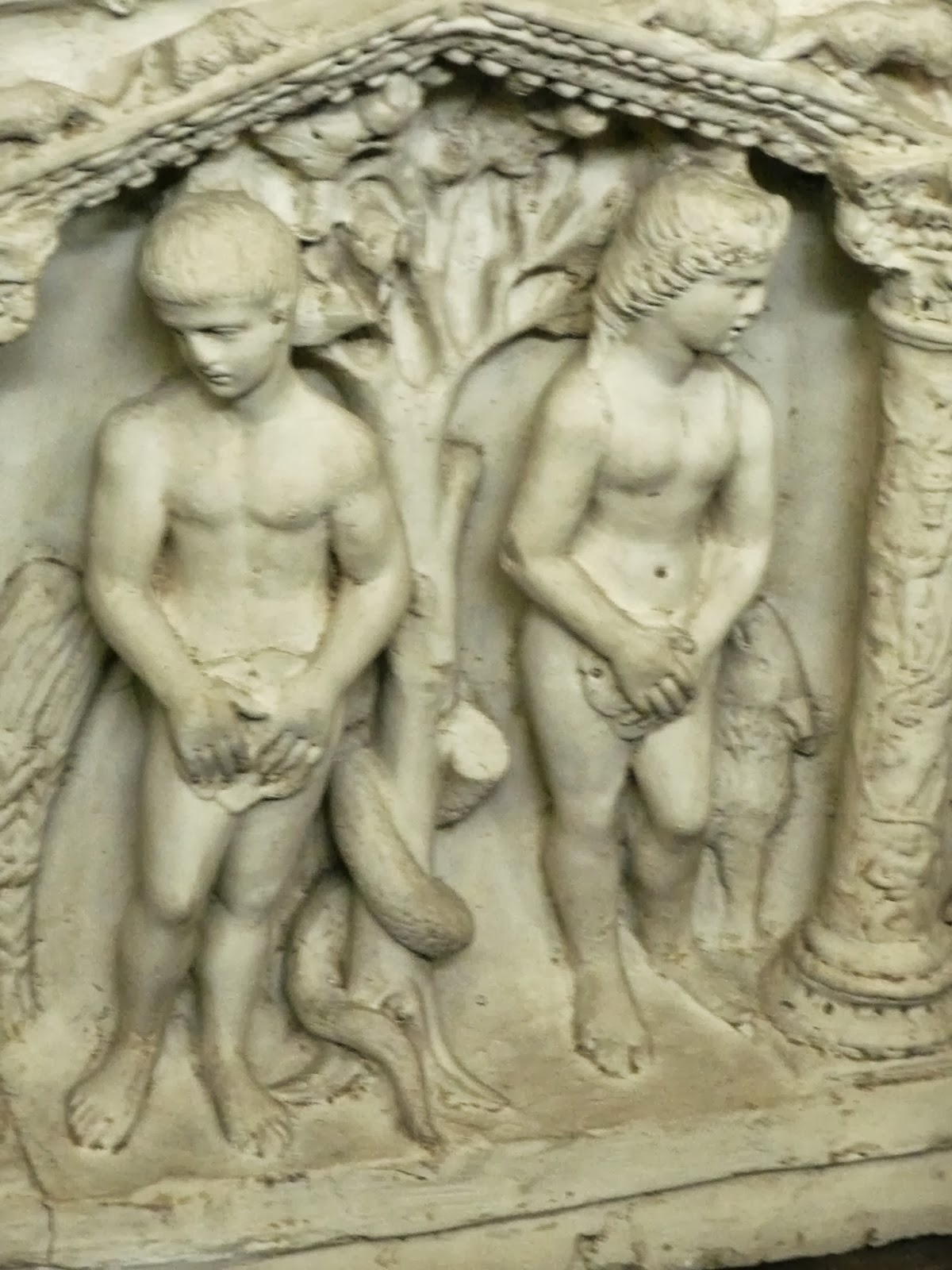
| Adam and Eve, detail of tomb (Gerald Watt) |
Read the “Confessions of St. Augustine” and you will begin to understand why we have to suffer simply because two young people picked and shared forbidden fruit. Why are we “attracted to evil” as one of the founders of my Congregation put the problem? Who would want to do bad? Who would choose to be evil?
Four yearling deer stood still not ten feet from me in the first light of an October morning. With their light grey, furry, pointed ears, huge dark eyes and black noses, they appeared out of a cool mist and startled me. I had turned a corner on the rustic path that I walk most days — and there they were.
The deer were browsing some of the last green leaves of Summer and were mildly interested in me standing there so close by. They made no attempt to move away: they just stood there munching, looking at me. So, I excused myself…I really did –out loud! I felt like I had interrupted their breakfast.
I continued down the path thinking about the abundance of deer so present these days even in our cities and suburbs. These deer are gentrified, completely at peace with the walkers and talkers who move through their environment. They are not domesticated, just habituated to the humans who must seem so curious to them.
There are far more deer in America than when the pilgrims arrived. As the forests of the East and Midwest were leveled and agriculture took over as much of the land as was possible, more brush and what environmentalists call “edge” appeared. One example of edge is the strip of vegetation that farmers leave along creeks and rivers that pass through their land. That’s where many species of birds find food and cover. It’s where deer live, too. They don’t live in the forest.
Years ago, the world’s expert on moose, deer and elk was Margaret Altmann, a researcher whose home bordered the Bridger Wilderness Reserve near Yellowstone. I went with her once on horseback through forests and brush while she observed white-tailed deer through a monocular. Her riding horses were unshod and stealthily made their way without disturbing the natural behavior of wildlife.
I wonder what she would say about our citified deer. I know one thing: She would be curious to know how civilized deer differ in behavior from wilderness deer. Margaret Altman has been gone for many years now but I think, were she alive, that she would be amazed how these deer accept us within their territories.