Monk’s Motto. Ora et Labora. (Prayer and Work.)
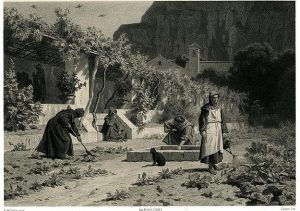
Brother Lawrence was a simple member of his order. His calling was to serve his fellow monks by working in the kitchen, the garden and performing other menial duties.
However, Brother Lawrence was awkward and distracted in his work. (Something like you and me, if we were to be honest about it.) The other monks had to be patient with his bungling, saint or not.
His fellow monks knew that he lived in the awareness of God’s presence. But Brother Lawrence was unaware of a lot of other things.
If it weren’t for his superiors, he never would have written down how he found the secret of remembering the presence of God. He felt he was simple and was just glad to contribute to community life as he was able while he thought of God always. His superiors made him write down how he lived in God’s presence while he worked.,
In my first year of religious life, I was expected to join my brothers for a holy hour, “meditation” we called it. We gathered in the chapel and the leader of prayer for the day, one of the seminarians, said “Let us place ourselves in the presence of God and adore and venerate Him profoundly.” A significant period of silence followed.
Then each fifteen minutes (45 minutes total) a scripture or meditative point was read. At the end of our holy hour, the leader said: “Let us take our resolutions. Somehow we were expected to do something new as the result of our meditation. We closed our holy hour meditating on thanksgiving to God: “Let us thank Him for all the graces that we have received,” another reminder of the presence of God.
From day one in the seminary, I was taught to practice the presence of God everyday and to always begin my day remembering his presence.
When you pray the first thing you should remember is that you are conversing with someone. The Someone is God Himself. Often our prayers are fervent but without awareness of His presence, otherwise we wouldn’t be talking so much.
Remembering the presence of God is listening to Him. That is the beginning and end of prayer. Read the little book of Brother Lawrence.
“Be still and know that I am God.” (Ps 46:10)
When Ezekiel on Mt Horeb was waiting for God to reveal Himself to Elijah’s soul, The earth shook violently, life’s foundation quaked. God was not in the earthquake. There was a volcanic eruption of fire like that which consumed Sodom and Gamorrah but no experience of God was there.
A gentle breeze like whisper made Elijah aware of God’s presence. Like Adam and Eve n the garden he hid himself naked he was before the Spirit that knows all things even the intimate thoughts of your human heart.
My mother put it this way when she thought I was not attending to what she said:
You’re like talking to the wall she said.
VPS in his wonderful work on meditation says that the first thing we should do in prayer, is remember the presence of God. Let it affect you. If you can’t stop your thoughts from flying where your lips are not or if you drift from Him in prayer. Prayer becomes nothing more than a duty to be done, a task to be completed while you think of something else, the next task.
The secret of praying is the secret to any communion with someone else. You simply are aware of the other person. Have you ever been in conversation with someone who never paused to take note of you?
What is prayer, anyway? being aware of the presence of God. Isn’t it funny that in he presence of the WORD we are often not listening but talking, talking. remember when jesus taught His disciples to pray He said, “Do not rattle on as he pagans do who think that by saying a lot of words they will honor God. When you pray “Our Father!”
People rushing around us going somewhere making us feel small so that in our sense of abandonment, our smallness within the universe, we shout “Abba!,” Father! And, He listens to our awareness.
What will you expect to see or hear as begin your prayer by being aware of the presence of God?
You will see what you always see when you being prayer. You’ll see the sanctuary of your church or the garden you see each morning as you begin your prayers on the back porch. Wherever you pray you are in the presence of God. But you do not see him or hear Him. A bird lands near the rosebush in your garden. The tabernacle is the same one you see each morning. His presence is in silence.
Practicing the presence of God is a dedication to seek God in every moment.
Isn’t he in the be




 This morning, I was reading “The Christian Century,” a protestant journal. The cover of the September 2026 issue depicts Christ Pantocreator because the “Feast of Creation in Christ,” is observed by some liturgical churches on September first. This was a decision of the World Council of Churches which is on a mission to make us Christians aware of our responsibility to value all that God has made, the vast universe of his creation.