
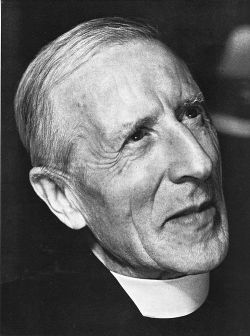
Teilhard de Chardin, 1947. Wikipedia, public domain.
I hesitate to write about getting old because I feel if I do, I might lose some of my readers. I prefer to be non-numerable or ageless. Still, there are advantages to being older because there is more leisure time to focus on what it all means. Teillard de Chardin was a Jesuit philosopher, paleontologist and spiritual writer. In his old age he came-up with a reflection that I recall now and then. You’ll find it in his book the Divine Mileau:
“When the signs of age begin to mark my body (and still more when they touch my mind); when the ill which is to diminish me or carry me off strikes from without or is born within me; when the painful moment comes in which I suddenly awaken to the fact that I am ill or growing old; and above all, at that last moment when I feel I’m losing hold of myself and am absolutely passive within the hands of the great unknown forces that have formed me; in all those dark moments, O Lord, grant that I may understand that it is You (provided only my faith is strong enough) who are painfully parting the fibers of my being in order to penetrate the very marrow of my substance and bear me away within yourself.” (Teilhard de Chardin, S. J., from his book: The Divine Milieu.)
Pierre Teilhard de Chardin was a priest who was also a research paleontologist. He wrote in French, a softer more nuanced language than English. A pre-Vatican II Church figure who often used scientific imagery to explain phenomena, a practice which did not please Church authorities, Chardin did not fit into the theological climate of the pre-Vatican church. He was accused of muddling theological and philosophical concepts with a vocabulary more proper to poetry. His writings were popular just before the Vatican Council and were considered dangerous and too liberal. The Vatican issued a montium — a warning– that believers should avoid his books. He was finally removed from his teaching positions and his license to teach theology was revoked.
Father Chardin, a Jesuit, accepted this rebuke and retired to a quiet life with his brother Jesuits in New York City. He was a man obedient to Church authorities and humbly accepted his rebuke. He lived out his life in study and prayer, often walking in New York’s Central Park and sitting on a park bench talking with children.
There is something unique about this Jesuit’s wondrous view of the universe and of humanity’s part in its renewal. He famously referred to Our Lord as the “Omega Point” or, the final Word in the Father’s ultimate plan. Only then will all things, the cosmos itself, be revealed in all its glory through Jesus Christ.
Just a moment! Please excuse me… I’m looking for my cane…. I’d like some time to wonder about all this.
I think I’ll take a walk in the park.